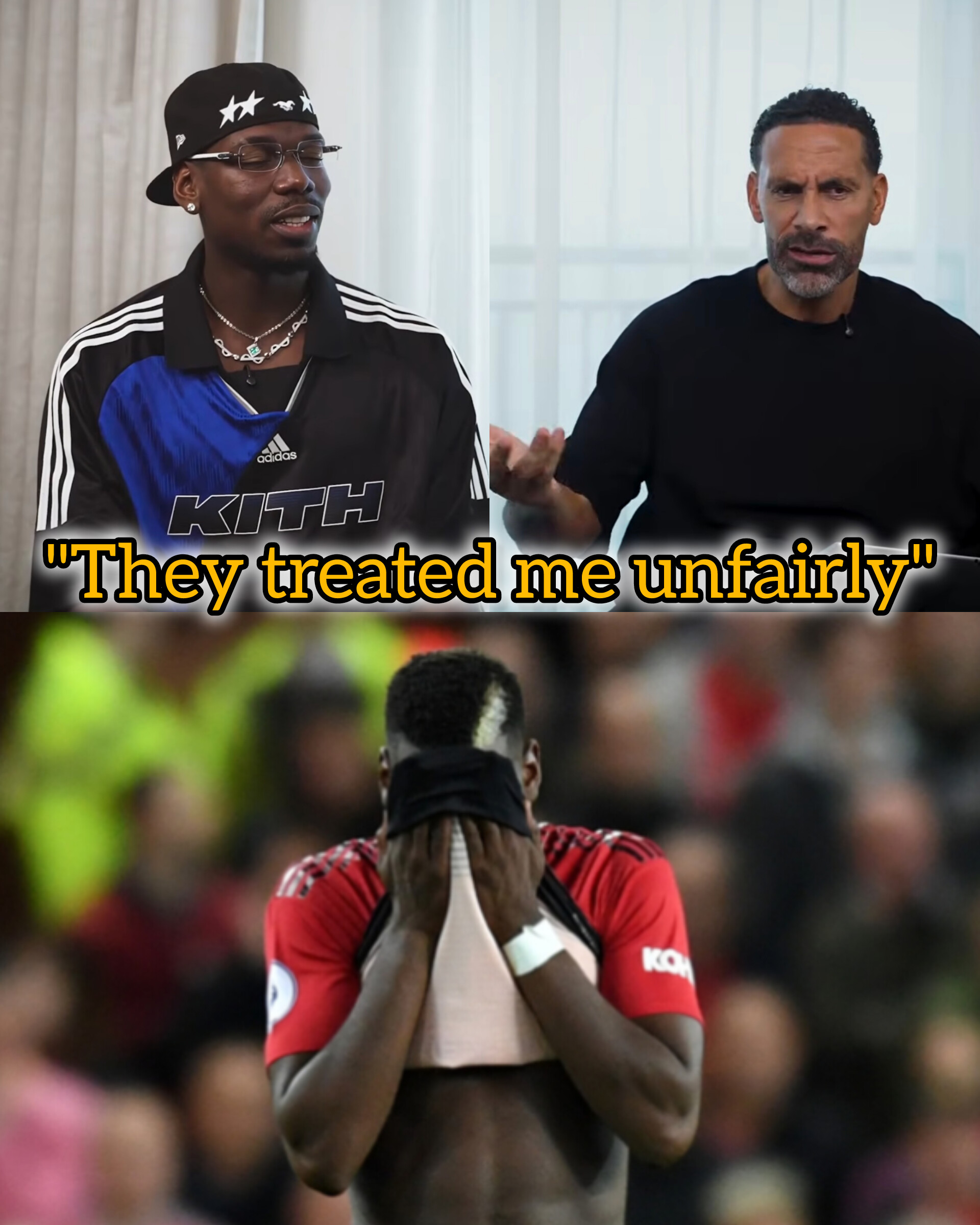
“They treated me unfairly” — Paul Pogba has finally opened up about his “toxic” end at Manchester United, claiming the club’s structure failed him during his second stint at Old Trafford!

In a searingly honest follow-up to his recent reflections, Paul Pogba has leveled a series of explosive allegations against the internal hierarchy at Manchester United. During his comprehensive dialogue with Rio Ferdinand, the French international didn’t just stop at expressing nostalgia; he pivoted into a sharp critique of the “toxic” environment that he claims fundamentally undermined his second tenure at Old Trafford. For the first time, Pogba has articulated a sense of systemic failure, suggesting that he was treated as a scapegoat for deep-seated organizational rot.
The “Failed Foundation” Critique
Pogba’s primary grievance centers on what he describes as a total lack of structural support. He contended that while he was recruited as the centerpiece of a new era, the club failed to surround him with the tactical or administrative consistency required to succeed. He argued that the frequent rotation of managerial philosophies—from the rigid discipline of José Mourinho to the transitional nature of subsequent regimes—left him and other high-profile players stranded without a clear identity.
The midfielder noted that at other elite European institutions, the club protects its stars from the storm; at United, he felt he was shoved directly into the eye of it. He characterized the internal atmosphere as “fragmented,” claiming that the lack of a unified sporting vision created a vacuum where blame could easily be shifted onto individual players rather than the decision-makers in the boardroom.
Allegations of Unfair Treatment
Perhaps the most stinging part of the interview was Pogba’s insistence that he was “treated unfairly” compared to his peers. He spoke about a perceived double standard where his personal life and off-field interests were weaponized against him by both the media and, occasionally, figures within the club.
“It became easy to point at me,” Pogba remarked. “If the team lost, it was the hair. If we drew, it was the dancing. I felt like I was playing a different game than everyone else—one where I had to be perfect just to be considered ‘average.’ They didn’t just fail to support me; at times, it felt like they were feeding the narrative that I was the problem.”
He lamented that the ” Pogba brand” became a convenient distraction for the club’s wider inability to compete at the highest level, alleging that he was often hung out to dry when internal leaks and dressing room politics began to dominate the headlines.
A Breakdown in Communication
Pogba also touched upon the “cold” nature of his final months at the club. He detailed a breakdown in communication regarding his fitness and contract negotiations, describing the period as one of immense isolation. He claimed that the club’s medical and coaching staff were often not on the same page, leading to a “toxic” cycle of injury and rushed returns that ultimately damaged his physical longevity and his reputation among the supporters.
The Legacy of a Broken Marriage
By the end of the conversation, it was clear that the “unfinished business” Pogba previously mentioned is deeply tied to a sense of injustice. While he maintains a love for the fans and the history of the badge, his assessment of the modern Manchester United machinery is one of profound disappointment.
For Pogba, the narrative of his “failure” in England is not a reflection of his talent, but a symptom of a club that had lost its way. He warned that until United addresses the “toxic” culture within its higher echelons, even the world’s greatest talents will continue to find themselves crushed by the weight of a broken structure. This interview serves as a final, defiant rebuttal to his critics, reframing his exit not as a departure, but as an escape.
