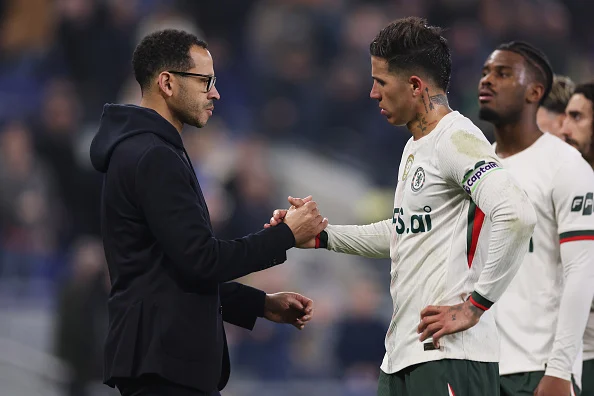
“It’s a tragedy. A club of this size being managed into the ground. He doesn’t have the profile for this job, and if they keep him, they are following the exact blueprint that destroyed Spurs. Chelsea fans deserve better than this slow death” — Gary Neville slams the “delusional” hope that things will improve under the current leadership. Following the United disaster, Neville believes Chelsea is just one season away from a “historic collapse.”
"Chelsea Is Just One Season Away From a Historic Collapse": Neville's Devastating Verdict After United Humiliation

The post-match analysis at Stamford Bridge had barely begun when Gary Neville delivered a eulogy. Not for the match—though Chelsea’s 2-1 defeat to Manchester United was damaging enough—but for the entire project. In a withering assessment that has sent shockwaves through the football world, the former Manchester United captain has declared that Chelsea is sleepwalking toward a “historic collapse.”
**”It’s a tragedy. A club of this size being managed into the ground. He doesn’t have the profile for this job, and if they keep him, they are following the exact blueprint that destroyed Spurs. Chelsea fans deserve better than this slow death.”**
That explosive verdict, delivered in the Sky Sports studio following Chelsea’s latest setback, represents the most damning indictment yet of Liam Rosenior’s tenure. But Neville’s critique extends far beyond the manager. He has laid the blame squarely at the feet of the ownership—warning that the “delusional” hope that things will improve under the current leadership is the first step toward a fate Chelsea fans cannot imagine .
## The Numbers That Tell the Story of Decline
The statistics since Rosenior’s appointment make for grim reading. Chelsea have won just **one of their last seven Premier League matches**, a run that has seen them concede 14 goals, including back-to-back 3-0 defeats to Everton and Manchester City . Their form under the former Strasbourg manager places them **ninth in the Premier League table** based on results since his arrival, averaging just 1.54 points per game .
For context, that is only a marginal improvement on the 1.46 points per game managed earlier in the season under Enzo Maresca . The “new manager bounce” that saw Rosenior win his first four league matches has long since evaporated, replaced by the same inconsistency that defined the Maresca era.
The projection is damning. If Chelsea continue at their current rate, they are set to finish with around **57 points**—a total that would almost certainly leave them outside the Champions League places . For a club that has spent over £1.5 billion on players since the 2022 takeover, that represents catastrophic underperformance .
## The Rosenior Profile: “He Doesn’t Have the Profile for This Job”
Neville’s criticism of Rosenior is not merely about results; it is about **fit**. The 41-year-old arrived from Strasbourg with a reputation for progressive coaching, having spent 18 months working under the BlueCo umbrella at Chelsea’s sister club . Chelsea co-owner Behdad Eghbali has publicly backed him, stating that the club “knew what we were getting” after working with him daily for that period .
But Neville’s argument is that the Premier League is not Ligue 1. The pressure of Stamford Bridge is not the pressure of the Stade de la Meinau. And a manager who has never competed at the sharp end of English football’s most demanding environment is not equipped to handle a club of Chelsea’s stature.
**”He doesn’t have the profile for this job,”** Neville charged.
The evidence is mounting. Chelsea under Rosenior have lacked a defined playing style, appearing disjointed and relying primarily on individual moments of brilliance . The team’s attacking output has been inconsistent, and defensively they have been vulnerable, conceding 14 goals in their last seven league matches and shipping six against PSG and Manchester City in recent weeks .
Eghbali has insisted that the ownership is committed to stability, acknowledging that “getting that stability on the manager side is one of the things we haven’t done right yet” . But for Neville, stability with the wrong manager is not a solution—it is a sentence.
## The Tottenham Blueprint: A Warning from History
Neville’s reference to the “exact blueprint that destroyed Spurs” is the most chilling element of his verdict. Tottenham Hotspur, once a perennial Champions League qualifier and a 90-minute from European glory in 2019, is now fighting relegation . The decline was not sudden; it was the cumulative effect of years of poor recruitment, managerial instability, and a loss of identity.
The parallels are uncomfortable. Like Spurs under Daniel Levy, Chelsea under BlueCo has prioritized financial sustainability and long-term asset value over on-pitch success . The “project” has been sold as a multi-year rebuild, but fans have grown impatient with the lack of clarity.
The Chelsea Supporters’ Trust has articulated this frustration: **”At the heart of supporter concern is a simple point: the current model has demanded a huge amount of faith from the fanbase, while giving too little clarity in return”** .
If Chelsea continue down this path, Neville argues, they will not just miss out on Champions League qualification for a season or two. They will become trapped in a cycle of mediocrity from which escape becomes increasingly difficult. The “slow death” he describes is not hyperbole; it is a prediction rooted in the recent history of English football’s fallen giants.
## The Ownership Problem: “Business First, Football Second”
Neville’s critique of Rosenior cannot be separated from his broader condemnation of the BlueCo ownership. He has previously described Chelsea’s underperforming players as **”billion-pound bottle jobs”** —a taunt that has dominated the media agenda and still rings in the ears of the squad .
The club’s financial figures justify the scrutiny. Chelsea announced a pre-tax loss of **£262.4 million** for the 2024/25 financial year—the largest annual loss in the history of English football . While the club avoided a points deduction through strategic accounting and “add-backs” for infrastructure, academy, and women’s team spending, the headline figure speaks to a business model under immense strain .
Eghbali has admitted that the transfer strategy will now shift, with the club looking to add **”more ready-made players”** to complement the existing core . He named six players he considers world class—Cole Palmer, Moises Caicedo, Enzo Fernandez, Levi Colwill, Estevao Willian, and Reece James—and insisted that “there’s no intention to rebuild every three or four years” .
But for fans who have watched the club drift from Champions League winners to mid-table also-rans, these words ring hollow. As football finance expert Kieran Maguire noted, Chelsea’s 40,000-capacity stadium leaves them “£50-60m behind” their rivals in revenue, and with new squad-cost ratio rules coming into force, “that will take its toll over time” .
## The Disconnect: Eghbali’s Optimism vs. Fan Reality
The gulf between the ownership’s messaging and the fanbase’s lived experience has never been wider. Eghbali has insisted that Chelsea are still in the **”40th, 50th minute”** of their process, that the core of elite players is in place, and that adding experience will take the team “to the next level” .
But the Chelsea Supporters’ Trust has pushed back forcefully. **”These concerns are not driven by short-term results, and they will not be resolved by them. They relate to the underlying direction of the club, and they will persist regardless of fluctuations on the pitch”** .
The planned protests ahead of the Manchester United match—in which Chelsea fans were joined by supporters of Strasbourg, also owned by BlueCo—reflect the depth of discontent. Organisers have described the ownership as overseeing the **”systematic destruction”** of both clubs .
For Neville, this disconnect is the root of the crisis. A club cannot be run like a hedge fund. Players cannot be treated as assets. And fans cannot be expected to accept a “project” that has delivered neither trophies nor a clear identity.
## The Verdict: A Season Away from Disaster
**”If they keep him, they are following the exact blueprint that destroyed Spurs.”**
Neville’s words are not just criticism; they are a warning. Tottenham’s decline was not sudden—it was the accumulation of years of poor decisions, misplaced priorities, and a loss of connection between the club and its supporters. Chelsea, under BlueCo, is walking the same path.
The “slow death” Neville describes is already visible. Chelsea have won one of their last seven league matches. They are ninth in the form table since Rosenior’s appointment. They face the prospect of finishing outside the Champions League places for the second consecutive season, with no guarantee of a swift return.
Liam Rosenior may yet prove his doubters wrong. He may yet develop the tactical acumen and man-management skills required to compete at the highest level. But Neville’s argument is that Chelsea cannot afford to wait for that development. A club of this size, with this history, with these resources, should not be a laboratory for managerial experiments.
The “delusional” hope that things will improve under the current leadership is, in Neville’s assessment, the first step toward disaster. Chelsea fans deserve better than a project without a plan, a manager without a profile, and an ownership without a clue.
At Stamford Bridge, the clock is ticking. And if the warning signs continue to be ignored, the “historic collapse” Neville predicts will not be a possibility—it will be an inevitability.
