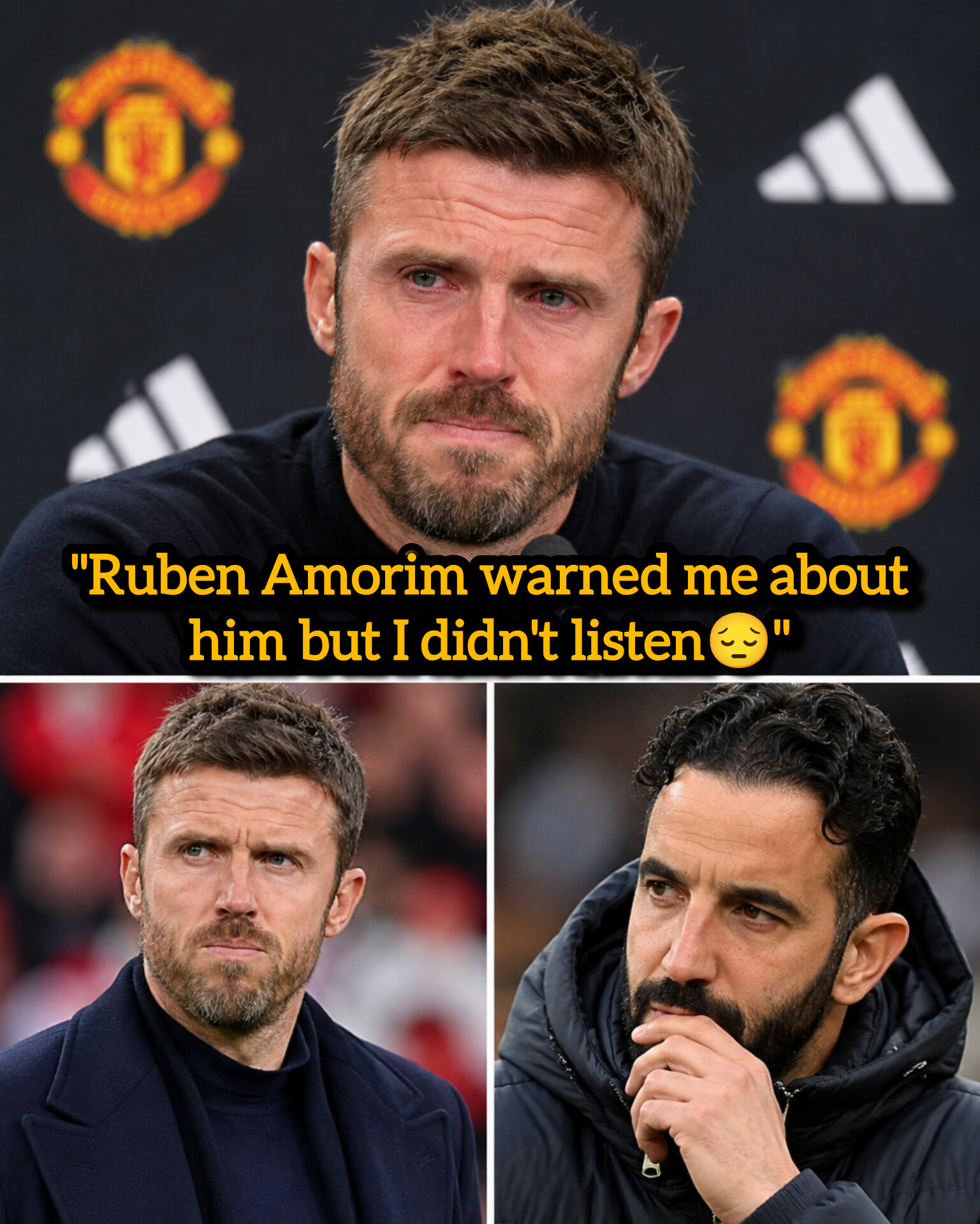
EXCLUSIVE: Tearful Michael Carrick Breaks Silence After Brutal INEOS Sacking—Admits Ruben Amorim Warned Him About “Toxic” United Star

EXCLUSIVE: “He Told Me He Would Destroy the Dressing Room”—Michael Carrick Breaks His Silence in Tearful Confession Following Brutal INEOS Sacking
Six months ago, Michael Carrick stood on the Old Trafford pitch as the conquering hero. Having stepped into the breach in January following the dismissal of Ruben Amorim, the former Manchester United midfielder orchestrated one of the most improbable turnarounds in modern Premier League history—guiding a fractured squad to a third-place finish and securing Champions League football. INEOS rewarded him with a permanent contract running until 2028, hailing the “winning culture” he had forged at Carrington.
Today, that culture lies in ashes, and Carrick is clearing out his desk.
Following a catastrophic start to the 2026/27 campaign—United’s worst opening to a league season in 40 years, leaving the club languishing 18th in the Premier League table—Sir Jim Ratcliffe, CEO Omar Berrada, and director of football Jason Wilcox pulled the trigger during the November international break. With a preliminary agreement already struck to bring in USMNT boss Mauricio Pochettino ahead of next week’s daunting trip to Anfield, Carrick has become the latest casualty of the Old Trafford managerial graveyard.
Speaking exclusively to our desk just hours after receiving the formal dismissal notice from Monaco, a visibly emotional and uncharacteristically candid Carrick pulled back the curtain on the toxicity that consumed his tenure—and revealed a chilling prophecy from his predecessor.
The Phone Call from Lisbon
Throughout his playing and coaching career, Carrick has been defined by stoicism. Yet, sitting in a quiet hotel lounge in Cheshire, the 45-year-old struggled to hold back tears as he recounted the events leading up to his exit.
According to Carrick, the seeds of his downfall were planted in the very first week he took the reins in January. Before Amorim departed England—prior to eventually taking the AC Milan job this past summer—the Portuguese tactician reached out to Carrick for a private, off-the-record handover.
> “After everything I’ve done for this club, this is how I’ve been treated!” Carrick said, his voice cracking as he recounted the board’s decision. “Ruben Amorim warned me about him when I took over, telling me he would destroy the dressing room from the inside—but I never listened, I gave him every chance, and now look where it has gotten me to…”
>
While Carrick stopped short of naming the individual for legal reasons, insiders at Carrington have pointed to severe friction within the senior leadership group in recent weeks. Following a dismal run of just two wins in 10 league matches—capped by a chaotic, defensively shambolic 4–4 draw against Aston Villa—tensions boiled over.
Publicly, cracks had already begun to show. Lisandro Martínez openly admitted after the Champions League defeat to Atlético Madrid that the club’s issues ran far deeper than the dugout, while club captain Bruno Fernandes—last season’s PFA Player of the Year—recently voiced pointed frustration over the team’s tactical direction. Behind closed doors, however, Carrick insists one specific senior figure actively undermined his authority whenever standards were enforced.
“Ruben pulled me aside before he left,” Carrick explained. “He looked me dead in the eye and said, ‘Michael, you are a good man, and you love this badge. That will be your weakness if you don’t cut the rot out on day one.’ He gave me a name. He told me that the moment things get tough, this player stops running, starts whispering to the press, and turns the younger lads against the staff.”
Blinded by Last Season’s Miracle
Why didn’t Carrick act? By his own admission, the intoxicating high of the spring blindfolded him.
When Carrick took over in January 2026, United were adrift, bruised by Amorim’s rigid 3-4-3 experiment. Carrick simplified the system, put an arm around bruised egos, and rode a wave of goodwill straight into the top three. That unnamed player was central to the resurgence, producing match-winning performances that convinced Carrick that Amorim’s warning had simply been the byproduct of a personality clash.
“I thought I could manage him,” Carrick admitted, staring down at his hands. “I thought, ‘I played in this dressing room under Sir Alex. I know what Manchester United requires.’ When we finished third and I signed the new deal in May, I went to the board and pushed to build around this core. I defended him in meetings. I protected him when his fitness dipped in pre-season. I gave him every single olive branch a manager can offer.”
By October, the dynamic had flipped entirely. With injuries mounting and results spiraling toward the relegation zone, the player reportedly began questioning Carrick’s training methods in front of academy graduates and leaking lineup discontent hours before kickoff.
“When we went two goals down to Villa, I looked at the pitch and saw players actively avoiding passing to each other,” Carrick said. “That’s when Ruben’s words hit me like a ton of bricks. It wasn’t a tactical issue anymore. The dressing room had been poisoned from within, and by the time I realized it, I had already lost the backing of the board.”
A Brutal Ending at Carrington
Perhaps the sharpest sting for Carrick was the manner of his departure. Despite intense media speculation linking Mauricio Pochettino to the hot seat, Carrick was left in limbo—taking first-team training at Carrington on both Tuesday and Wednesday mornings without a single phone call from the hierarchy.
“I stood out there on the grass in the rain yesterday morning running drills, preparing for Liverpool at Anfield, knowing full well they were in Monaco negotiating with my replacement,” Carrick said bitterly. “No one from INEOS had the decency to look me in the face until the ink was practically dry. You give 15 years of your life to a football club—as a player, a coach, a caretaker, a manager—and you find out your fate through the morning papers.”
What Comes Next for United—and Pochettino?
As Manchester United finalize the €8 million-plus release clause to extract Mauricio Pochettino from his post with the United States Men’s National Team following their upcoming friendlies against Haiti, the Argentine faces a sobering reality.
United sit in the bottom three, morale is at rock bottom, and the fixture list offers no mercy—beginning with a trip to Anfield on November 22, followed swiftly by a high-stakes Champions League clash in Lisbon.
Pochettino has built a reputation as a master man-manager capable of galvanizing young, fractured squads. Yet, as Michael Carrick walks away from Old Trafford heartbroken and betrayed, his parting words serve as a stark warning to the incoming regime: until Manchester United addresses the toxicity inside its own walls, no manager—not Amorim, not Carrick, and perhaps not even Pochettino—will survive the storm.
