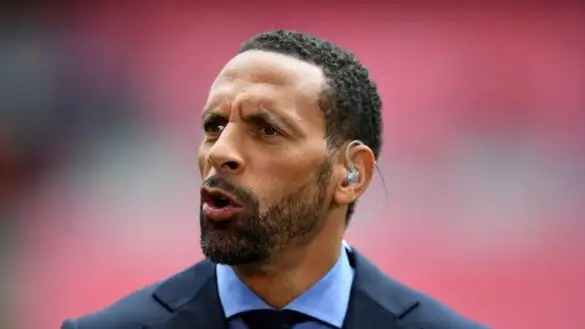
“I’ve spoken to a lot of players, but Diogo’s honesty here is on another level. He’s naming the problems that have been killing this club for years.” Rio Ferdinand has reacted to Diogo Dalot’s “quite surprising” feelings on Ruben Amorim after the Portuguese star admitted that the manager’s honesty “hurt” the squad!
The Painful Truth: Dalot's Raw Confession Exposes the "Problems Killing Manchester United for Years"

The Painful Truth: Dalot’s Raw Confession Exposes the “Problems Killing Manchester United for Years”
In an era of carefully crafted soundbites and diplomatic evasions, genuine honesty from a footballer is rare enough to be genuinely shocking. When that honesty cuts to the heart of a club’s deepest dysfunctions, it becomes something more: a **mirror held up to an institution in crisis**.
**”I’ve spoken to a lot of players, but Diogo’s honesty here is on another level. He’s naming the problems that have been killing this club for years.”**
Rio Ferdinand’s reaction to Diogo Dalot’s recent comments captures the magnitude of what the Portuguese defender has done. In the aftermath of Ruben Amorim’s tumultuous tenure and subsequent sacking, Dalot has broken ranks—not to criticise individuals or deflect blame, but to articulate the **raw, uncomfortable truth** about what it feels like to play for a club perpetually at war with itself.
## The Confession That “Hurt”
The core of Dalot’s revelation centres on his reaction to Amorim’s brutal honesty as a manager. When Amorim arrived at Old Trafford, he brought with him a communication style utterly foreign to the modern game: **unfiltered, direct, and uncompromising** . He didn’t protect egos or soften messages. He told the truth as he saw it, regardless of the consequences.
For Dalot, that truth landed like a punch to the gut.
**”Personally it hurts a lot when the manager says what he’s said,”** Dalot admitted . **”But it is just something he is really honest about. He doesn’t hide his emotions. He doesn’t hide the type of communication he wants to express – and that makes him an honest guy, an honest person.”**
This is the paradox Dalot articulates: the same honesty that “hurt” was also the quality that made Amorim worthy of respect. In a dressing room accustomed to platitudes and managed messaging, a manager who spoke without filter was simultaneously **destabilising and refreshing** .
## The Meaning of Pain
Dalot’s most profound insight lies in his interpretation of that hurt:
**”It is really hard these days to find managers and players like him. But if it hurts you, it’s a good sign because it means you want to change things. He is speaking about my team, my team-mates, my club. I don’t want to hear my manager and anybody else around the club feeling like that. So what can I do to change that?”**
This is not the reaction of a player retreating into defensiveness. It is the response of someone who **cares deeply enough to be wounded**—and who channels that wound into a determination to improve. For Dalot, Amorim’s public criticisms were not attacks to be resented but **calls to action** to be answered.
## The “Problems Killing This Club”
Ferdinand’s framing of Dalot’s honesty as naming “the problems that have been killing this club for years” points to something deeper than managerial conflict. The issues Dalot implicitly references include:
### 1. A Culture of Complacency
For years, Manchester United have been accused of accepting mediocrity. Players arrive, collect wages, and depart without ever feeling the weight of the shirt. Dalot’s insistence that Amorim’s criticism “hurts” because he cares suggests that this culture of complacency has been precisely the problem—and that **honesty, even painful honesty, is the only cure** .
### 2. Fragility Under Pressure
United’s recent history is defined by collapses when it matters most. Dalot himself has acknowledged this fragility, admitting after the FA Cup exit to Brighton that **”every attack that they [the opponents] have has to be a big threat to us”** —a damning indictment of defensive insecurity . He has urged teammates to play with **”hurt and anger,”** to become **”a bit more obsessed about playing for this club, winning games and winning trophies”** . These are not the words of a player content with the status quo.
### 3. Instability and Short-Term Thinking
Dalot has experienced the full chaos of United’s recent years. Signed under José Mourinho in 2018, he has played under Ole Gunnar Solskjaer, Ralf Rangnick, Erik ten Hag, Ruben Amorim, and now Michael Carrick—including multiple interim spells . This revolving door of management has created an environment where **long-term development is impossible** and players are constantly adapting to new demands.
After Amorim’s sacking, Dalot described the situation as **”really difficult”** —a period where the squad must **”find ways to solve problems really quickly”** and **”adapt and go again”** . This constant adaptation takes a psychological toll that accumulates over years.
### 4. The Burden of Expectation
Playing for Manchester United means carrying the weight of history. Dalot has spoken about how **”even after winning three or four games in a row, people will expect you to win five or six or seven”** . This relentless pressure, combined with the club’s inability to sustain success, creates a cycle of hope and disappointment that grinds down players and fans alike.
## The Amorim Paradox: Why Honesty Divided the Dressing Room
Amorim’s approach was always going to be polarising. Some players, like Dalot, appreciated the transparency and saw it as a necessary corrective to years of soft management. Others, reportedly, resented being called out publicly and struggled to reconcile the manager’s demands with his inability to deliver results .
Dalot acknowledged this tension, noting that Amorim **”doesn’t hide his emotions”** and that **”it is really hard these days to find managers and players like him”** . The very qualities that made him refreshing also made him difficult—and ultimately, the results didn’t arrive quickly enough to justify the discomfort.
The sacking came as a surprise to players, even if the writing had been on the wall after Amorim’s explosive press conference less than 24 hours before his departure . For Dalot, who was not just a player but a distant relative of Amorim, the departure was personally significant .
## Dalot’s Own Journey: From Scapegoat to Leader
The irony of Dalot being the one to articulate these truths is that he himself has been through the full cycle of criticism and redemption at United. Under Amorim, he was often deployed as a wing-back on both flanks—a position that exposed his limitations and drew fierce criticism from fans .
Amorim was once furious with Dalot for back-to-back blunders against Nottingham Forest, **”having a go at Dalot over his positioning”** after the defender failed to track a run or follow up on a give-and-go with Bruno Fernandes . Dalot was considered by many to be the **”weakest link”** in United’s lineup .
Yet under Michael Carrick, restored to his natural right-back role in a settled back four, Dalot has been transformed. Rio Ferdinand himself recently praised Dalot as looking like a **”different player”** —composed, disciplined, and consistent . Against Tottenham, he delivered one of his best performances of the season, contributing an assist and showing the defensive solidity that had previously been questioned .
This personal journey gives Dalot’s honesty additional weight. He has experienced the lows of being a scapegoat and the highs of redemption. He understands what it takes to survive at a club that eats its own.
## The Ferdinand Connection: Why This Matters
Rio Ferdinand’s reaction is significant because he represents the standard against which current United players are measured. A six-time Premier League winner and Champions League victor, Ferdinand knows what a winning culture looks like from the inside. When he says Dalot is naming the “problems that have been killing this club for years,” he is **validating the critique from the perspective of someone who lived the alternative**.
Ferdinand has also been watching Dalot’s resurgence closely. He recently highlighted how a return to right-back under Carrick has unlocked the defender’s potential, bringing **”renewed confidence and clarity”** to his game . For Ferdinand to now praise Dalot’s honesty suggests the player is growing not just as a performer but as a **leader and voice** within the dressing room.
## What Dalot’s Honesty Reveals
The significance of Dalot’s comments extends beyond any single manager or season. They reveal:
1. **A player who cares enough to be hurt**: In an era of mercenary footballers, Dalot’s emotional investment in United’s fate is genuine and deep.
2. **A squad struggling to process constant upheaval**: The revolving door of managers and the perpetual instability take a toll that Dalot is honest enough to acknowledge.
3. **The value of truth in a culture of evasion**: Amorim’s approach, however uncomfortable, offered something United have lacked: a leader willing to speak without a filter.
4. **The possibility of change**: If players like Dalot are willing to be hurt, to reflect, and to commit to improvement, there is hope that the culture can shift.
## The Road Ahead
As United navigate the remainder of the season under Carrick, with the permanent managerial situation unresolved and the summer window approaching, Dalot’s honesty serves as both a warning and a foundation. The problems he implicitly names—instability, complacency, fragility—will not disappear overnight. But **naming them is the first step toward solving them**.
Dalot has also remained committed to United despite interest from Real Madrid and Bayern Munich, both of whom made formal approaches for the defender in January . He has **”rebuffed the initial informal approaches”** and reiterated his **”total belief”** in the Old Trafford project . This is not a player looking for an escape route; this is someone determined to be part of the solution.
## The Final Word
When Rio Ferdinand says he’s “spoken to a lot of players” but Dalot’s honesty is “on another level,” he is acknowledging something rare and valuable. In a sport dominated by platitudes and protection, Dalot has done what few dare: he has spoken the truth about what it feels like to play for a club in crisis.
**”He’s naming the problems that have been killing this club for years.”**
Not with anger or blame, but with the quiet conviction of someone who has lived through it all and refuses to pretend. That honesty hurts—but as Dalot himself understands, the hurt is proof that change is still possible.
At Manchester United, a club drowning in noise and dysfunction, one player’s willingness to speak plainly may be the most hopeful sign of all.
